
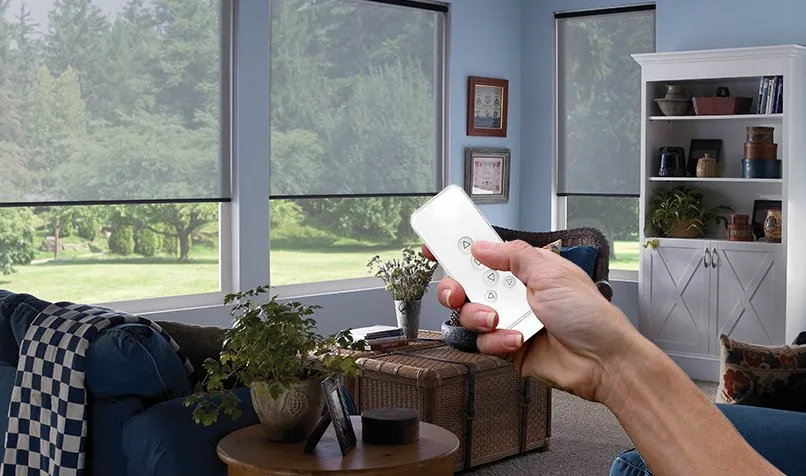
Motorized window treatments have moved from a luxury reserved for high-end builds to a practical upgrade any homeowner can add. Whether it’s a hard-to-reach skylight, a two-story great room window, or simply the convenience of opening every shade in the house with one tap, motorization changes how people actually use their window coverings day to day.
This guide covers how motorized systems work, what options are available, what installation involves, and how to decide whether motorization is worth it for your home.
What Motorized Window Treatments Actually Are
At its core, a motorized window treatment replaces the manual cord, wand, or chain on a blind, shade, or drapery with a small motor built into the headrail. That motor can be triggered by a handheld remote, a wall-mounted switch, a smartphone app, or integrated into a smart home system alongside voice assistants and automation routines.
The covering itself — cellular shades, roller shades, roman shades, draperies, even some shutter styles — stays largely the same. What changes is how it’s operated, which opens up scheduling, remote access, and hands-free control that manual coverings simply can’t offer.
Why Homeowners Choose Motorization
Convenience. Raising or lowering every shade in a room, or the whole house, with a single tap replaces the daily routine of walking window to window.
Hard-to-reach windows. Skylights, transom windows, and tall great-room windows are often impossible to operate manually without a ladder or extension pole. Motorization solves that permanently.
Energy efficiency. Scheduling shades to close during peak afternoon sun and open during cooler morning hours helps regulate indoor temperature and can meaningfully reduce cooling costs in summer months.
Child and pet safety. Traditional cords present a strangulation hazard in homes with young children or pets. Motorized systems eliminate dangling cords entirely, which is why cordless and motorized options are increasingly the standard recommendation for nurseries and playrooms.
Enhanced privacy and security. Scheduling shades to open and close on a set pattern while traveling gives a home a lived-in look, and instant one-touch privacy control is useful for any room facing the street.
Smart home integration. Motorized shades connect into most major smart home ecosystems, allowing them to work alongside lighting, thermostats, and voice assistants as part of a broader automation routine.
Types of Motorization Options
| Option | How It’s Controlled | Best For |
|---|---|---|
| Remote-controlled | Handheld remote | Simple upgrades, budget-friendly |
| Wall switch | Fixed wall-mounted control | Rooms with consistent, single-zone use |
| App-controlled | Smartphone/tablet app | Whole-home control, scheduling |
| Voice-integrated | Smart speaker/voice assistant | Hands-free operation, smart homes |
| Solar-powered motors | Self-charging via small solar panel | Hard-wiring not practical, eco-conscious households |
| Battery-powered motors | Rechargeable battery pack | Retrofits without accessible wiring |
Most homeowners end up mixing a few of these across a home — battery or solar-powered motors in rooms where running wiring isn’t practical, and hardwired or app-controlled systems in newer builds or full renovations where wiring is easier to plan for upfront.
Battery, Solar, or Hardwired: Which Power Source Fits Your Home?
This is usually the first real decision point once someone commits to motorization. Hardwired systems offer the most reliable, maintenance-free power but require either new construction or accessible wiring paths, which makes them best suited to renovations or new builds. Battery-powered motors are the most flexible for retrofitting into existing homes since no wiring changes are needed, though the battery pack does need periodic recharging depending on how often the shades are used. Solar-powered options work well for windows that get consistent daylight, essentially eliminating the recharging step, but they depend on adequate sun exposure to stay charged.
What Installation Involves
Motorized window treatments are more involved to install correctly than manual ones, which is where working with an experienced installer matters most.
Site assessment. A technician measures each window and evaluates power access, wall structure, and whether hardwiring is realistic or a battery/solar motor makes more sense.
Product and motor selection. Based on the window size, covering style, and how the homeowner wants to control it, the right motor type and control method get matched to each room.
Mounting and wiring. Headrails are mounted, motors installed, and any necessary wiring run and connected — either to existing power or to a dedicated line if hardwiring was chosen.
Programming and pairing. Remotes, apps, or smart home hubs are paired to each motor, and any scheduling or grouping (such as “all upstairs shades”) gets configured at this stage.
Testing and walkthrough. Every shade is tested through its full range of motion, and the homeowner is walked through operating the system before the installer leaves.
Is Motorization Worth the Investment?
Motorized shades cost more upfront than manual versions, and it’s a fair question whether the difference is worth it. For most households, the value comes down to a few specific situations: windows that are physically difficult or unsafe to reach manually, homes with young children where cord safety is a real concern, rooms that benefit from scheduled operation for energy savings, and anyone who wants their window treatments to function as part of a broader smart home setup. For a straightforward, easily-reached window in a home without smart home ambitions, manual coverings may still make the most sense — motorization tends to deliver the most value where convenience or safety were already a pain point.
Maintaining a Motorized System
- Keep the motor housing free of dust buildup
- Recharge or replace batteries on schedule for battery-powered units
- Periodically test full range of motion to catch early signs of motor strain
- Keep firmware and app software updated for app-controlled systems
- Avoid manually forcing a motorized shade, which can damage the motor mechanism
With reasonable care, quality motorized systems are built to run for years with minimal issues.
Frequently Asked Questions
Can existing blinds or shades be retrofitted with motors? In many cases, yes — certain shade and blind styles can be retrofitted with battery-powered motor kits without replacing the entire covering, though a professional assessment is the best way to confirm compatibility.
Do motorized shades work during a power outage? Battery and solar-powered motors continue working normally during an outage since they don’t rely on home power. Hardwired systems may lose function unless connected to a backup power source.
How loud are motorized shade motors? Modern motors are designed to run quietly, typically producing a soft hum that’s barely noticeable during normal operation.
Can one remote or app control shades in multiple rooms? Yes — most systems allow shades to be grouped by room or zone, so a single command can control several windows or an entire floor at once.
Final Thoughts
Motorized window treatments turn a daily chore into a one-touch convenience while adding real safety, energy, and smart home benefits along the way. The right setup depends on the home’s wiring situation, which windows are involved, and how much smart home integration the household actually wants — which is exactly why a proper site assessment before installation matters. For homeowners weighing their options, KC Blind Guys, Inc brings the product knowledge and installation experience to match the right motorization setup to each room.